
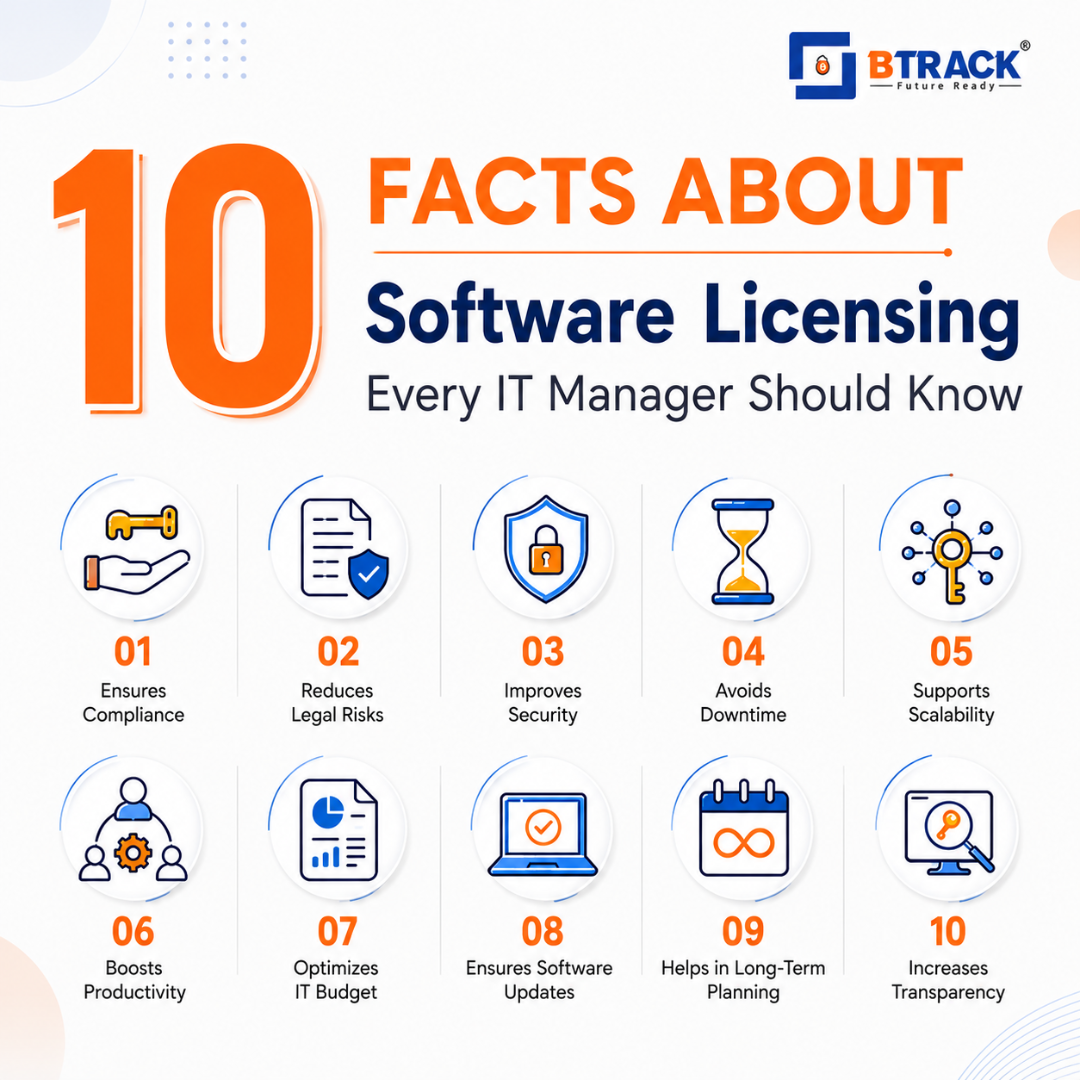
10 Facts About Software Licensing Every IT Manager Should Know
10 Facts About Software Licensing Every IT Manager Should Know
For Btrack India Private Limited " written in a clear, practical style with short paragraphs and short sentences. Use this as a blog post, a downloadable guide, or website content. Internal link included: www.btrackindia.com
Software licensing is a core business and technical topic. Yet many IT managers treat it as legal paperwork. That's a mistake. Licensing affects budgets, security, compliance, and business agility. Below are 10 essential facts every IT manager should know " explained simply, with real-world tips and actions you can take today.
1. There are many types of software licenses " know which you use
Not all licenses are the same. Each has different permissions and limits.
Common types:
- Perpetual license " pay once, use forever. Often no upgrades included.
- Subscription license " pay monthly or yearly. Includes updates and support.
- Concurrent/seat license " limited number of simultaneous users.
- User-based license " assigned to named users.
- Device-based license " tied to a machine.
- Open-source license " free to use but may require attribution or source disclosure (GPL, MIT, Apache).
- Enterprise license agreements (ELAs) " company-wide, negotiated terms.
Why it matters: Choosing the wrong model can increase cost or block growth. Always map the license type to how your team actually works.
2. License compliance isn"t optional " it's a business risk
Non-compliance can lead to fines, reputational damage, and legal action.
Real risks include:
- Audits by software vendors.
- Unexpected penalties for over-deployment.
- Reputational loss if sensitive data is exposed while using unlicensed tools.
What to do:
- Maintain a single source of truth for licenses.
- Run periodic audits (automated where possible).
- Keep purchase records, invoices, and EULAs organized.
A proactive compliance approach reduces surprises and protects budgets.
3. Software audits are common " be prepared
Vendors run license audits to verify usage. Audits are stressful but manageable.
Preparation checklist:
- Keep invoices and proof of purchase.
- Log deployments and license keys.
- Keep a current inventory of installed software.
- Have a designated audit owner on your team.
If audited:
- Respond quickly and transparently.
- Ask for clear timelines and data they need.
- Negotiate remediation (e.g., phased purchases rather than penalties).
Being ready reduces legal exposure and speeds resolution.
4. Cloud and hybrid environments complicate licensing
Cloud adoption changed licensing rules. Many traditional licenses weren"t built for cloud or hybrid infrastructure.
Common cloud licensing challenges:
- Bring Your Own License (BYOL) rules vary by vendor.
- Metered/usage-based billing can surprise teams.
- License mobility (moving licenses between on-prem and cloud) is limited or restricted.
Best practices:
- Review vendor cloud policies before migration.
- Use cloud-native licensing for faster scaling.
- Track cloud usage to control costs and prevent drift.
Cloud licensing requires constant attention " not a one-time checklist.
5. Open source has benefits " and obligations
Open-source software (OSS) reduces cost and accelerates development. But it comes with legal obligations.
Key points:
- Licenses vary: permissive (MIT, Apache) vs copyleft (GPL).
- Copyleft licenses can require sharing changes or distributing source code when you ship a product that includes GPL code.
- Using OSS in proprietary products needs careful review.
Actionable steps:
- Maintain a Software Bill of Materials (SBOM).
- Use an OSS policy and approval workflow.
- Scan for vulnerable or improperly licensed OSS components.
Treat open source as both an opportunity and a compliance item.
6. License management tools save time and money
Manual tracking is error-prone. License management and Software Asset Management (SAM) tools automate discovery and reporting.
What these tools do:
- Detect installed software across endpoints and servers.
- Match installations to purchased licenses.
- Report compliance gaps and unused licenses.
- Integrate with procurement systems.
Popular features to look for:
- Agentless discovery for servers.
- Cloud discovery for SaaS and IaaS.
- Usage insights for subscription optimization.
ROI: Proper tooling reduces overspend and lowers audit risk.
7. SaaS proliferation brings new licensing patterns
Software-as-a-Service (SaaS) is now the default for many business apps. SaaS licensing differs from traditional models.
SaaS considerations:
- Per-user pricing can grow quickly.
- Inactive or orphaned accounts cost money.
- Add-on modules and premium features may be hidden expenses.
- Data residency and contract terms matter for compliance.
Tips:
- Implement tight onboarding and offboarding for SaaS.
- Reclaim or reassign unused licenses regularly.
- Negotiate enterprise pricing when many seats are required.
SaaS is convenient " but costs must be actively managed.
8. Negotiation leverage can save millions " prepare before renewal
Most vendors expect negotiations. If you go in unprepared, you lose leverage.
How to prepare:
- Know your usage metrics and growth forecasts.
- Identify overlapping or redundant tools.
- Time renewals to align with budget cycles.
- Consolidate vendors where possible for volume discounts.
Negotiation tactics:
- Ask for multi-year discounts.
- Request training credits or premium support as part of the deal.
- Consider moving underutilized spend to a cloud or subscription alternative.
Even small percentage discounts can lead to significant annual savings across large estates.
9. Effective license governance requires people, process, and technology
Good license governance is organizational, not just technical.
Governance components:
- People " clear roles: procurement, IT operations, legal, and business owners.
- Process " standardized procurement workflows, approval gates, and renewal reminders.
- Technology " SAM tools, CMDB integration, and usage monitoring.
Make license governance part of IT operations. Assign an owner. Create regular reporting. Tie license metrics to KPIs and budgets.
10. Security, cost control, and business agility all depend on licensing strategy
Licensing touches three core IT outcomes:
- Security: Unpatched or unauthorized software increases risk.
- Cost control: Unused or misallocated licenses drain budgets.
- Agility: Rigid licensing models can slow deployments and innovation.
Integrate licensing strategy into broader IT strategy:
- Use cloud and subscription models where agility is key.
- Keep critical security tools properly licensed and updated.
- Reinvest license savings into innovation.
A strategic approach to licensing lets IT enable business goals instead of hindering them.
Bonus " Practical checklist for IT managers
Use this quick checklist to audit your current state.
- Inventory: Create/update a centralized inventory of all software and licenses.
- Ownership: Assign license owners for each major product.
- Documentation: Store invoices, contracts, and EULAs in one place.
- Tooling: Deploy a SAM or license management tool.
- SaaS Controls: Implement onboarding/offboarding and periodic license reclamation.
- OSS Policy: Publish an OSS usage policy and maintain an SBOM.
- Renewal Calendar: Maintain a renewal and audit calendar with reminders.
- Budgeting: Allocate a software renewal budget and optimization plan.
- Security: Ensure all critical software is patched and licensed.
- Negotiation Prep: Collect usage data 60—90 days before renewals.
Real-life example (short)
A mid-sized company paid for 1,000 SaaS seats. After a license audit and reclamation drive, they found 30% inactive accounts. Reassigning or cancelling those seats saved tens of thousands per year. They used a SAM tool, automated offboarding, and added license usage checks to the HR exit process. Result: lower costs and stronger security posture.
FAQs
Q: Can I ignore open-source license obligations for internal tools?
A: Internal use often has fewer obligations. But if you distribute products or services that include OSS with copyleft terms, you must comply. Track OSS usage regardless.
Q: Is perpetual licensing cheaper long-term?
A: It can be for stable, long-lived software without frequent upgrades. But subscriptions include updates and often reduce upfront costs. Evaluate total cost of ownership.
Q: What's the biggest cause of license non-compliance?
A: Shadow IT and unmanaged SaaS subscriptions. Employees signing up for apps outside procurement creates unmanaged licenses and risks.
Action plan: 30"60"90 days
30 days
- Build a simple inventory.
- Identify top 10 expensive products.
- Set up renewal reminders.
60 days
- Deploy or trial a SAM tool.
- Run a usage audit on top 5 SaaS apps.
- Reclaim unused licenses.
90 days
- Negotiate or optimize top renewals.
- Publish OSS policy and SBOM process.
- Embed license checks into procurement and HR processes.
Final thoughts
Software licensing is more than legal paperwork. It's a lever for cost control, security, and speed. Treat licensing as an ongoing program — not a one-time task. With a clear inventory, the right tools, and disciplined processes, your team can reduce risk and free budget for strategic projects.